
The Ten Area Codes in Virginia
Ten codes serve the Commonwealth. They cover six regions, not ten, because four of the regions carry a pair of codes that share identical territory. Northern Virginia has 703 and 571. The Richmond region has 804 and 686. The Valley and southwest corridor has 540 and 826. Hampton Roads has 757 and 948. The remaining two regions run on a single code each, 434 in the south-central counties and 276 in the far southwest.
Every one of these traces back to 703. That code was Virginia's original assignment when the national numbering plan was drawn up, and for a quarter century it was the only code the state had. Each later code came out of a split, where a chunk of territory was cut away and renumbered, or an overlay, where a second code was simply added on top. Virginia has used both methods, splits first and overlays since 2000.
| Area Code | Coverage | Year Assigned | Overlay Status |
|---|---|---|---|
| 703 | Northern Virginia core, including Alexandria, Arlington, Fairfax, Falls Church, Loudoun, Manassas, Manassas Park, and Prince William | 1947 | Original Virginia code, overlaid by 571 |
| 571 | Identical Northern Virginia territory to 703 | 2000 | Overlay of 703 |
| 540 | Shenandoah Valley, Roanoke, New River Valley, Fredericksburg, Winchester, Warrenton, Harrisonburg, Staunton, Blacksburg | 1995 | Split from 703, overlaid by 826 |
| 826 | Identical territory to 540 | 2022 | Overlay of 540 |
| 757 | Hampton Roads and Tidewater, including Virginia Beach, Norfolk, Chesapeake, Portsmouth, Suffolk, Hampton, Newport News, Williamsburg, and the Eastern Shore | 1996 | Split from 804, overlaid by 948 |
| 948 | Identical territory to 757 | 2022 | Overlay of 757 |
| 804 | Richmond capital region, Ashland, Charles City, Chesterfield, Henrico, New Kent, Petersburg, Northern Neck, much of the Middle Peninsula | 1973 | Split from 703, overlaid by 686 |
| 686 | Identical territory to 804 | 2024 | Overlay of 804 |
| 434 | South-central Virginia, including Charlottesville, Lynchburg, Danville, South Boston, and Farmville | 2001 | Split from 804, no overlay |
| 276 | Southwest Virginia, including Bristol, Abingdon, Galax, Martinsville, Wytheville, Wise, and Norton | 2001 | Split from 540, no overlay |
Virginia Area Code Coverage by Region
Reading the map by region works better than reading it by code, since half the codes are twins. A caller who says they are in Roanoke and a caller who says they are in Winchester can both be telling the truth about a 540 number. That code stretches from the Potomac corridor down through the Valley to the New River, which is a long way in one region.
- Northern Virginia - 703 and 571, covering the dense inner suburbs of Washington and the Loudoun and Prince William growth areas
- Valley, Roanoke, and the northwest - 540 and 826, from Winchester and Fredericksburg through Harrisonburg and Staunton to Roanoke and Blacksburg
- Richmond and the tidewater rivers - 804 and 686, from Ashland and Henrico through Chesterfield and Petersburg out to the Northern Neck and Middle Peninsula
- Hampton Roads and the Eastern Shore - 757 and 948, taking in the seven cities, the Williamsburg area, and the shore counties
- South-central Virginia - 434 alone, covering Charlottesville, Lynchburg, Danville, Farmville, and South Boston
- Southwest mountains - 276 alone, covering Bristol, Abingdon, Galax, Martinsville, Wytheville, and the Wise and Norton area
Codes in Virginia follow numbering geography, not political geography. Independent cities do not get their own codes, and county lines do not always match the edge of a code. A locality near the boundary of two regions is worth checking directly rather than guessing from the map.
Overlay and Split in Virginia
These two words describe the only two ways to add numbers to a region that has run out, and Virginia has lived through both. A split redraws the boundary. Half the region keeps the old code, the other half gets a new one, and everybody in that second half has to change their number. An overlay leaves everyone alone and simply lets a second code be issued in the same place. The trade-off is the dialing rule, since two people on the same street can now hold the same seven digits under different codes.
- Split
- The old boundary is cut in two. One side keeps its numbers. The other side is renumbered onto a new code, and every business there reprints everything.
- Overlay
- A new code is issued alongside the old one in the same territory. Nobody is renumbered. New lines get whichever code has stock left.
- Permissive dialing
- The grace window during a changeover when the old and new dialing patterns both connect. It ends on a set date.
- Exhaust
- The point where a code has no unassigned prefixes left. Forecasts of exhaust are what start a relief case in the first place.
Virginia's recent relief for 757, 540, and 804 all used the overlay method. The State Corporation Commission favors it for the obvious reason. Nobody loses a number they have had for thirty years.
Ten Digit Dialing Across Virginia
In every overlay region, a local call takes the area code plus the seven-digit number. That covers 703 and 571, 540 and 826, 757 and 948, and 804 and 686. Long distance calls inside the country add a 1 in front of those ten digits. The rule is not only about overlays, though. The national rollout of 988 forced the same change on any Virginia region where 988 was already in use as a local exchange, because a seven-digit call starting with those three digits would have been ambiguous.
Important: Seven-digit local calls no longer connect in Virginia's overlay regions. Dial the area code every time, and store saved numbers the same way.
The 804 region shows how the two reasons stack up. Its customers moved to mandatory ten-digit local dialing in July 2022, a year and a half before 686 was ready, purely because of the 988 conflict. By the time the overlay arrived, the habit was already in place. Service codes, star codes, and the international prefix are covered on the Virginia phone codes page.
How Virginia Area Codes Changed
The pattern over eighty years is easy to follow. One code became four through splits, then four became ten through overlays. Splits ran from 1973 to 2001 and each one moved a whole region onto new numbers. Once mobile phones, fax lines, alarm panels, elevators, and later VoIP started eating prefixes faster than households ever did, the state switched approach and stopped renumbering anyone.
| Year | Event |
|---|---|
| 1947 | 703 assigned to Virginia as its original code |
| 1973 | 804 split from 703 for eastern and central Virginia |
| 1995 | 540 split from 703, leaving 703 with Northern Virginia only |
| 1996 | 757 split from 804 for Hampton Roads, Tidewater, and the Eastern Shore |
| 2000 | 571 goes live as an overlay of 703, the state's first |
| 2001 | 276 split from 540 for Southwest Virginia |
| 2001 | 434 split from 804 for south-central Virginia |
| 2022 | 826 overlays 540 and 948 overlays 757 |
| 2022 | 804 moves to mandatory ten-digit local dialing because of 988 |
| 2024 | 686 becomes available over 804 |
Note: the years above mark when each code went into service, which is often later than the year it was approved.
Virginia's Newest Code, 686
The 686 overlay is the most recent change to the Virginia area code map, and the SCC laid out the details in a news release.
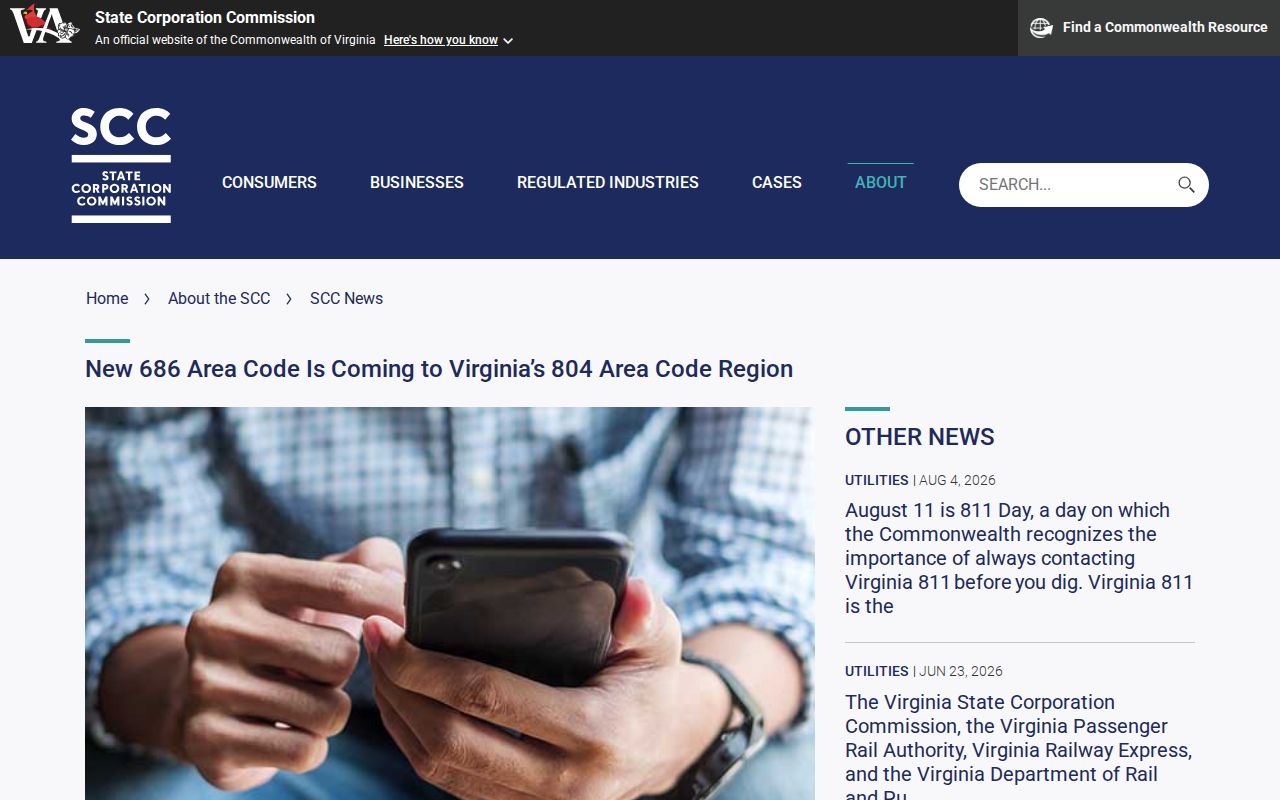
The January 2024 announcement put 686 directly over the 804 territory, naming central Virginia, Richmond, Ashland, Charles City, Chesterfield, Henrico, New Kent, Petersburg, and the Northern Neck. Assignments could start on February 1, 2024, but not before 804 actually ran dry, which was forecast for the third quarter of that year. The commission approved the plan back in November 2022.
Two points in that release matter to residents. Existing 804 customers keep their numbers, full stop. And the relief is expected to hold for roughly 32 years, so nobody in the region should expect another code any time soon. The release also confirmed that the three-digit service numbers stay three digits.
Local Exchange Prefixes Under Virginia Codes
Underneath the area code sits the prefix, the three digits that come next. In the old landline world those prefixes were parceled out to rate centers and central offices, which is why certain prefixes used to mean certain towns. Northern Virginia had rate centers around Alexandria, Arlington, Fairfax, Herndon, Reston, Leesburg, Manassas, and Woodbridge. The Richmond region had Richmond, Chesterfield, Henrico, Petersburg, Ashland, and Mechanicsville. Hampton Roads had Norfolk, Virginia Beach, Chesapeake, Portsmouth, Hampton, Newport News, and Williamsburg exchanges, plus the Eastern Shore.
That mapping still exists in industry records, but it is weaker than it used to be. In a large code like 540, the prefix tells you far more than the code does, because 540 covers Winchester, Fredericksburg, Harrisonburg, Staunton, Roanoke, Salem, Blacksburg, and Christiansburg all at once. Prefix detail as a dialing topic is covered on the phone codes page.
What a Virginia Area Code Cannot Tell You
An area code used to be an address. It is not anymore. Number portability lets a customer keep the same digits after changing carriers, and in many cases after changing the type of service entirely. Someone who grew up in Arlington can carry a 703 number to Bristol, or to Colorado, and never change it. A VoIP line can be issued with a Virginia code and answered by someone who has never set foot in the state.
Scam callers know all of this. Spoofing lets a caller display any number they want, which is why a call showing a local Virginia code and a familiar prefix still deserves the same scrutiny as any other. Treat the code as a hint about where a number started, not as proof of where the caller is now. The step-by-step verification routine lives on the Virginia phone numbers page.
Future Area Codes for Virginia
No further Virginia relief is on the books in the official material reviewed here. The three most recent overlays, 686 over 804, 948 over 757, and 826 over 540, were all put in place to buy decades rather than years, and the 804 pairing alone is projected to last about 32 years. The two single codes, 434 and 276, serve smaller populations and have no announced partner.
If a new code ever is needed, the process is predictable. NANPA forecasts the exhaust date for the region. The State Corporation Commission opens a case, takes public comment, and picks between an overlay and a split. Comments can be mailed to the Document Control Center in Richmond or filed electronically under the case number. For residents, an overlay decision usually means no action at all, since existing numbers stay put and the dialing rule in Virginia's paired regions is already ten digits.
Verifying a Virginia Area Code
Two federal sources settle any question about whether a code is genuine and which state it belongs to. The numbering administrator publishes the authoritative record.
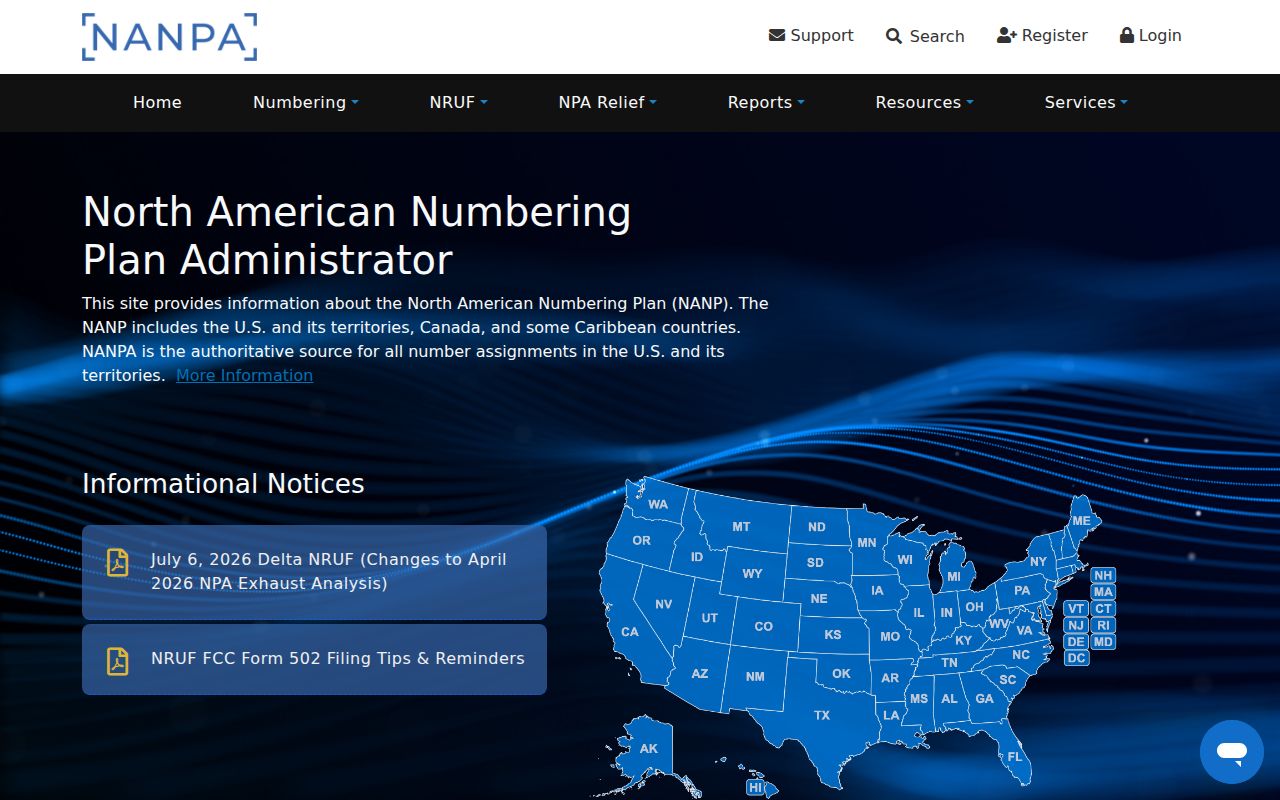
NANPA is where planning letters and relief information are published, so it is the right place to confirm that a code exists and to check the status of a region. The FCC keeps a plainer consumer summary for anyone who does not want the industry detail.